
Our Choices Have Consequences: Notes on Don Giovanni
/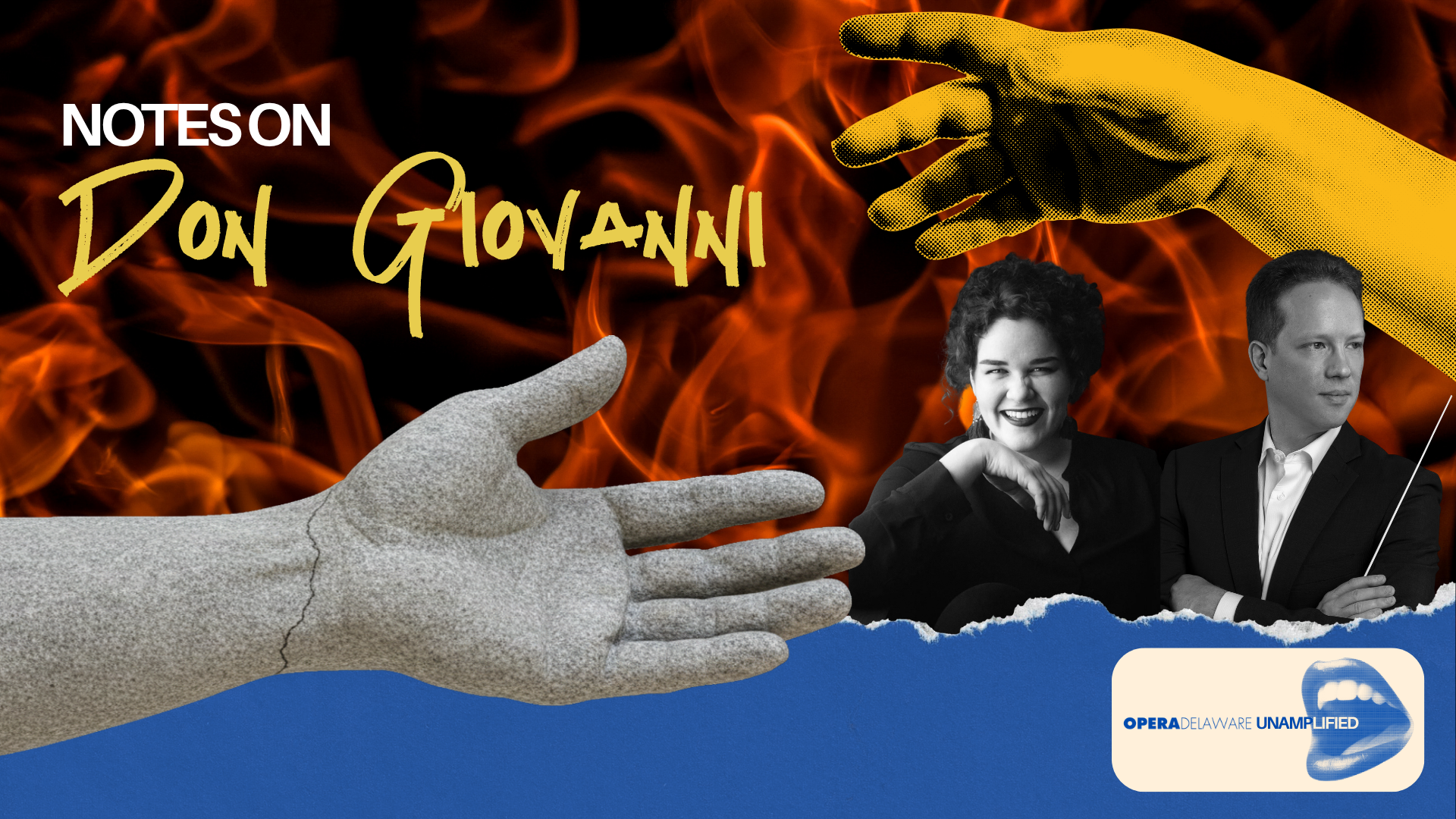
Ahead of our production of Don Giovanni opening October 16 at The Grand Opera House, stage director Haley Stamats and conductor Joshua Horsch share their perspectives on Mozart and Da Ponte's enduring "dramedy" — and why, nearly 240 years after its Prague premiere, it continues to implicate its audience in ways they don't always see coming.
Haley Stamats, Stage Director:
“If you do bad things, you will have consequences.”
It’s a simple lesson, and it’s the one Mozart and Da Ponte leave us with in the epilogue of Don Giovanni. At its core, Giovanni is a morality play with traditional themes of temptation, a fall from grace, repentance, and salvation or damnation of the human soul — but this morality play is told through the blended genre of opera buffa and opera seria known as a dramma giocoso, or, for us, a “dramedy.”
Yet there is real tragedy at the heart of our dramedy: the issue of consent. Giovanni moves through the world taking what he wants with little regard to the people he harms, and if anything, he seems addicted to the power trip of getting away with it, always searching for his next conquest. Eventually, the human world can’t hold Giovanni accountable, and the supernatural world has to intervene.
If Giovanni is our villain, then the rest of our characters are their own anti-heroes, all of them living in the moral gray area of humanity. Leporello condemns his master’s libertine ways yet enables him, Donna Elvira knows what Giovanni did to Donna Anna and yet still loves him and believes him capable of redemption, and Donna Anna’s grief drives her toward vengeance for her father’s death, raising the question of whether an “eye for an eye” is ever truly right. But their complexity and flaws do not diminish the harm Giovanni has inflicted.
What makes this show so menacing is how funny it truly is — we delight in disguises, crude jokes, clever manipulation, and “suspension of disbelief” circumstances, but by the end we are confronted with the reality that these circumstances are no laughing matter, and we realize, even as voyeurs into this world, that we have been participating in its moral ambiguity by laughing all night long.
Giovanni isn’t damned because everyone else is “good” — he is damned because he repeatedly chooses to harm others and refuses to repent for it. And so, after an evening spent laughing, desiring, grieving, and scheming alongside these deeply imperfect people, Mozart and Da Ponte remind us of a very simple lesson:
Our choices have consequences.
Joshua Horsch, Conductor:
When Mozart and his brilliant librettist Da Ponte premiered Don Giovanni in Prague in 1787, they created a work that defies easy categorization — while it may lack the neat, symmetrical poise of The Marriage of Figaro, Don Giovanni replaces that classical balance with an overwhelming emotional thrust and electrifying dynamic energy, representing a massive leap forward in Mozart’s continuing development of operatic technique by unifying the entire score into a single, relentless forward momentum where every note advances the drama.
Mozart also ties specific musical personalities directly to his characters, with the notable exception of Giovanni himself, who chameleon-like mirrors the music of whoever he is trying to seduce or outsmart — a device that makes him both impossible to pin down dramatically and irresistible to watch.
The most striking example of Mozart’s thematic unity starts right from the Overture, where two thunderous D-minor chords pull us into the shadows of fate, the very same motif that reappears in the opera’s climax when the Stone Guest comes to drag Giovanni to hell. A less obvious but equally fascinating detail occurs at the end of Donna Anna and Don Ottavio’s early Act I duet, where the striking, repeated unison notes that close their duet are quoted almost verbatim at the exact moment Giovanni is swallowed by darkness in Act II, musically sealing the vow of vengeance taken at the start of the opera.
As you listen, keep an ear tuned to how these musical structures elevate the narrative — from the iconic seduction duet “Là ci darem la mano,” where Giovanni and Zerlina’s vocal lines slowly intertwine as she succumbs to his charm, to the Act I ball scene featuring three separate bands playing in different time signatures simultaneously, Mozart’s score reflects the chaotic human spirit and refuses to give us easy answers. Lean in, enjoy the drama, and let the music pull you into Giovanni’s irresistible, perilous world.
Don Giovanni (Mozart/Da Ponte)
October 16 + 18 | The Grand Opera House
Get your tickets!
Produced in collaboration with Opera Baltimore