
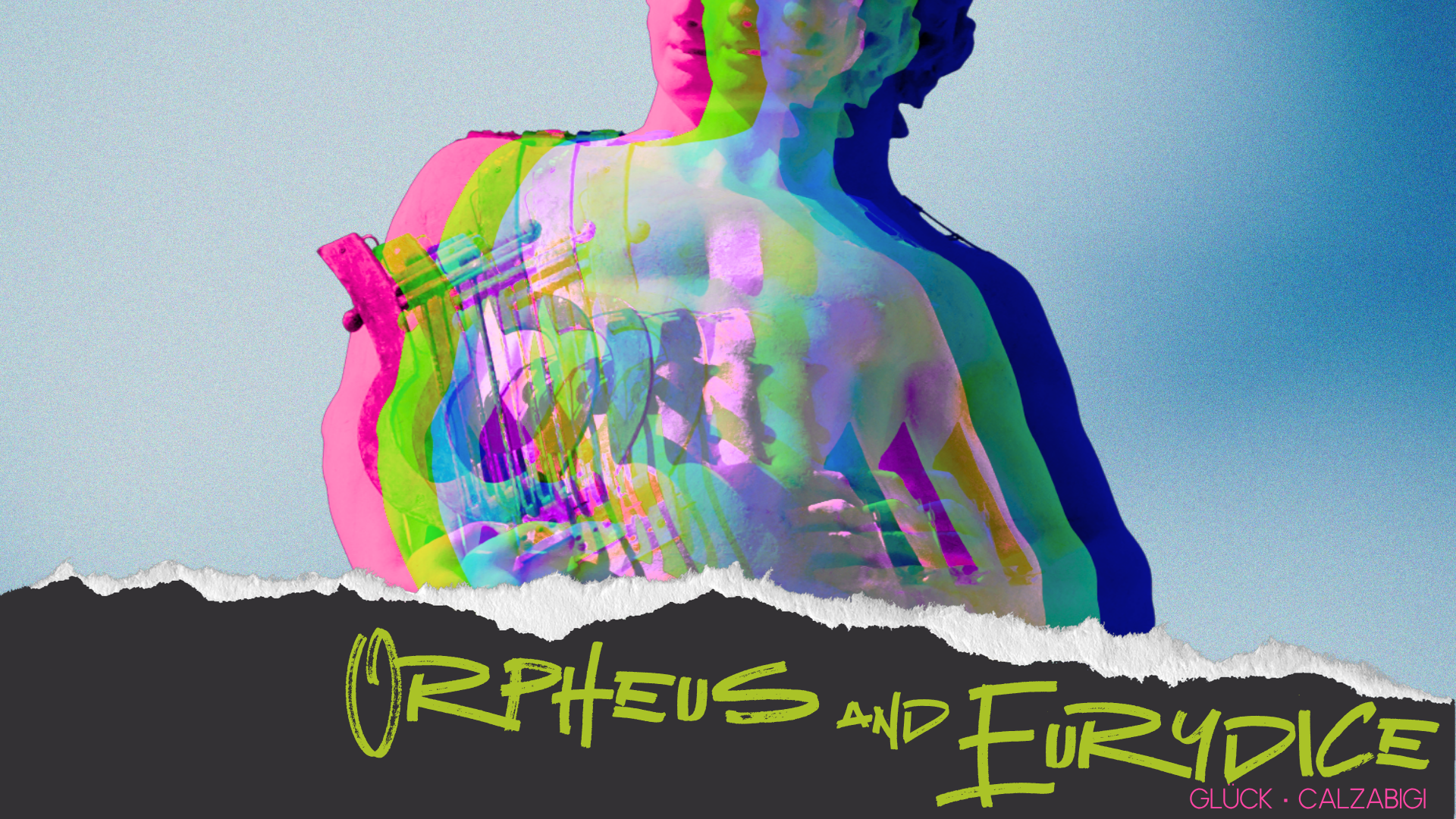
Artwork by Dane Suarez
Music by Christoph Willibald Glück
Libretto by Ranieri de Calzabigi
May 21, 2027 | 7:30PM
May 23, 2027 | 2:00PM
Performances at The Grand Opera House
Sung in Italian with English supertitles
Running time: 1 hour and 40 minutes (no intermission)
The myth of Orpheus and Eurydice asks whether love is strong enough to conquer death. Gluck combines music and dance in his retelling of this iconic Greek tragedy. Orfeo ed Euridice is a meditation on death that cuts to the raw emotion of a man overcome by loss who descends into Hell for love only to lose everything in a single moment. Can love conquer fate to reunite these mythic lovers? Join OperaDelaware and First State Ballet on May 21 and 23 at The Grand Opera House to follow this hero’s journey home. Produced in partnership with First State Ballet Theatre.
A love story that will take you to hell and back.
the Cast of orpheus and eurydice

Emily Margevich as Eurydice

Jennifer Zetlan as Amore
the creative team of Orpheus and Eurydice

Katurah Stickann, director

Anthony Barrese, Conductor
Gluck's Orpheus and Eurydice was written in 1762 with a libretto by Ranieri de' Calzabigi and was a revolutionary departure in style from the operas of the time, featuring deeply emotional, vulnerable singing and heavy dance elements throughout. The composer designated it an azione teatrale (a theatrical action) and the title is precise because this is not an opera about spectacle or dramatic vocal display. It is a human story about what a person will do for love, and what love costs.
The opera centers on Orpheus, a poet and musician of supernatural gifts, standing at the tomb of his wife Eurydice. He does not open with a grand aria announcing his presence and his talent. He opens with a single word, repeated three times over a chorus of mourners: Eurydice. Eurydice. Eurydice. This is a story about a man who has lost everything.
Hearing his grief, the god Amore (Love) appears with an offer: Orpheus may descend into the Underworld and return with his wife, but he must not look at her until they reach the living world. He must lead her out of Hell in silence, offering no explanation, no reassurance, no glance of confirmation. He must trust Love, and Eurydice must trust him, and the cruelty of this story is that trust alone may not be enough.
At the gates of the Underworld, the fearsome Furies block his path, and Orpheus does what only he can do. He sings. His lyre, rendered in the orchestra as a shimmering harp, softens the immoveable Furies who relent to his song. He passes through into the Elysian Fields, radiant and serene, and finds no comfort in their beauty because Eurydice is not yet beside him.
When the pair are united, the journey home finally begins. Eurydice is unaware of the conditions set by Amore and interprets Orpheus’ silent refusal to look at her as a confirmation that he no longer loves her. The pair are near enough to touch one another but held apart by the cruel demands of fate. Will they survive the journey home and reunite in the world above?
Synopsis
-
Eurydice’s grave. Nymphs and shepherds lament the death of Eurydice, who was bitten by a snake (“Ah, se intorno a quest’urna funesta”). Left alone, Orpheus, Eurydice’s husband, adds his voice to the rites (“Chiamo il mio ben così”). Only Echo replies. Orpheus vows to rescue Eurydice from the underworld (“Numi! barbari numi”).
Amor, god of love, appears with word that Jove, pitying Orpheus, will allow him to descend into the land of the dead to retrieve Eurydice. To make this trial more difficult, Orpheus must neither look at Eurydice, nor explain why looking is forbidden. Otherwise he will lose her forever (“Gli sguardi trattieni”). Orpheus agrees and begins his voyage.
-
The Gate of Hades. Furies and ghosts try to deny Orpheus passage to the underworld (“Chi mai dell’Erebo”). His lament softens and placates them. He is eventually allowed to pass through to the Elysian Fields.
Elysium. Orpheus is moved by the beauty of the landscape (“Che puro ciel”). Heroes and heroines bring Eurydice to him (“Torna, o bella, al tuo consorte”). Without looking at her, he takes her away.
-
A dark labyrinth. Orpheus leads Eurydice toward the upper world, forbidden to look at her (“Vieni, segui i miei passi”). Orpheus can’t explain (“Vieni, appaga il tuo consorte!”). Eurydice panics at the thought of a life without the love of Orpheus (“Che fiero momento”). In desperation he turns to her. She dies, again. Grief-stricken, Orpheus wonders how he can live without her (“Che farò senza Eurydice?”). He decides to kill himself. Amore appears and stays Orpheus’ hand. In response to Orpheus’ deep love and devotion, Amore revives Eurydice. The three return to Earth.
The Temple of Love. Orpheus, Eurydice, Amore, the nymphs, and the shepherds all celebrate the power of love (“Trionfi Amore!”).